History
.jpg) It all started when Hazef al-Assad, the father of Bashar al-Assad, became president of Syria in 1971. He seized power by overthrowing the government and declared himself the ultimate leader. Then after 30 years of leading Syria, he died in 2000, and his son Bashar al-Assad (photo on the left) followed him up without any sort of elections.
It all started when Hazef al-Assad, the father of Bashar al-Assad, became president of Syria in 1971. He seized power by overthrowing the government and declared himself the ultimate leader. Then after 30 years of leading Syria, he died in 2000, and his son Bashar al-Assad (photo on the left) followed him up without any sort of elections.
Then on the 18th of December 2010, a young man from Tunisia set himself on fire after officials stopped him selling vegetables. Protests started in Tunisia and 300 people were killed during the unrest. This lead to even bigger protests and the start of the Arab Spring. In the Arab Spring, many countries in the Arab world started protesting against the government and many governments were thrown over or the ruler had to abdicate. This Arab Spring is also going on in Syria, since president Bashar al-Assad is still the ruler and the Syrian people want to get rid of him.
Then in the early spring of 2011, the Syrian Civil War began and nationwide protests started against President Bashar al-Assad's government. He had apparently arrested and tortured some teenagers who painted revolutionary slogans on a school wall. Also, the protests were a follow-up as part of the Arab Spring, because the Syrian people thought that Assad had been president for long enough. However, president Assad responded with violence to crack the protests, which did not work out well and many people were killed. The protests gradually changed into an armed conflict after months of fighting against the military.

Up to January 2015 this has happened in the Civil War:
It started in March 2011 when protests were set up against the government. President Assad tolerated this up to July and then decided to act against them with military force. Then in November, everything escalated. The Syrian protest groups became the Syrian opposition against the Military and the fighting became more aggressive. Then in April 2012, the United Nations launched the Kofi Annan peace plan to have a ceasefire between both sides. This was only for a short period of time, because the fighting started again in June. Then in July up to October there was a massive fight between the two sides. They both wanted to take over Damascus and Aleppo. (the capital and the largest city) From November 2012 to April 2013, the rebels had a lot of attacks against the Syrian government, but from April to June, the government partnered up with Hezbollah to get a lot of attacks against the rebels. Up to this day, both the rebels and the government are still fighting against each other. Since January 2014 they both also have an extra problem, IS is quickly taking over parts of Syria. Although the Civil War has therefore become a little bit less important, the fight still goes on between the opposition and the government.
The map of Syria at the moment:
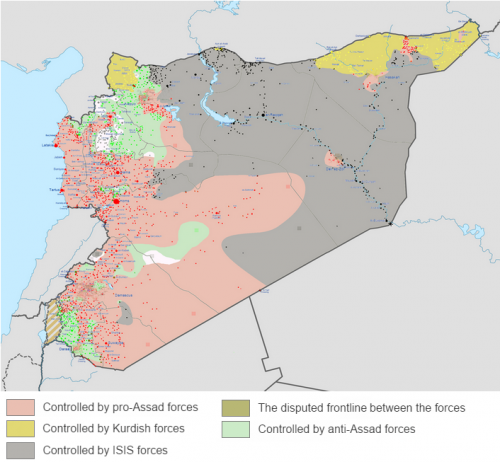
The map of Syria at the moment:
Since we found this YouTube video with a very good explanation of the conflict, we thought "why not place it here?"